
Private Jet vs Driving: Cost, Time and Safety Compared
November 26, 2026
For a regional trip of a few hundred miles, the real comparison is not a ticket price against a tank of gas. It is a whole day on the interstate against a short flight between two small airports, split across everyone on board. With a whole-airplane charter that seats up to five, the cost per person can land closer to a long drive than most people expect, and the hours you get back are the part a mileage calculator never shows. Below we put cost, time and safety side by side so you can run the numbers on your own route.
LittlebirdMake Regional Trips Work for Your GroupLittlebird connects regional airports with fixed aircraft pricing, so groups of up to five can share the cost of a private flight.VisitTL;DR
- Driving wins on out-of-pocket cost for short hops with a full car. A charter starts to make sense when the drive eats most of a day, or when several people split one fixed whole-airplane price.
- Littlebird prices the entire aircraft, not individual seats, so a group of up to five divides one fixed price. Austin to Dallas is listed at $1,417, about $283 per person with five aboard.
- Count more than fuel when you compare: your hours, hotel nights, meals and parking belong in the math.
- On safety, federal-data studies show flying far safer per mile than driving. Even general aviation compares well against passenger vehicles in one widely cited index.
- Every Littlebird aircraft carries the Cirrus Airframe Parachute System (CAPS), and pilots follow standardized safety training.
Table of Contents
- What you are really comparing
- The cost of driving, counted honestly
- The cost of a private flight, split across the group
- A worked example: Austin to Dallas
- Door-to-door time: where flying pulls ahead
- Safety: what the data says about flying vs driving
- Privacy, comfort and the little things
- How to decide: a quick routine
- Book your regional flight with Littlebird
- Our perspective
- FAQ
- Sources
What you are really comparing
A car and a private flight are different products. Driving is cheap per mile, flexible, and you leave from your own driveway. A charter is a fixed price for an entire airplane that flies between regional airports, so you skip the hub connection and the security line. The question is how long each takes and what each costs once you count everything.
That is why the same trip can look expensive on a spreadsheet and cheap in practice. A 200-mile drive is simple on paper. A 600-mile drive is a long day, maybe an overnight, and a missed morning or evening on either side.
The cost of driving, counted honestly
Start with the number the IRS publishes. For July 1 through December 31, 2026, the standard business mileage rate is 76 cents per mile. That figure bundles fuel, depreciation, insurance and maintenance, and it is revised periodically, so check the IRS page for the rate in effect when you travel.
As an illustration, a 200-mile one-way drive at 76 cents comes to $152. That is for the whole car, no matter how many people ride in it. It is the cheapest line in this comparison, and we will not pretend otherwise.
The mileage rate leaves out what a longer drive adds:
- Your time. Hours behind the wheel are hours not spent working, resting or with family. If you bill, or someone is waiting on you, put a dollar figure on each hour.
- Lodging and meals. Anything over a long day tends to turn into a hotel night and extra restaurant meals.
- Tolls, parking and rental fees at the destination.
- Fatigue. The longer the drive, the more it affects how sharp you are when you arrive.
For a two-person business trip, those extras often double the real price of the drive. Writing them down is the only way to compare fairly, and a travel expense categories checklist helps you split a shared trip’s costs cleanly among the people traveling.
The cost of a private flight, split across the group
Littlebird sells the whole airplane at one fixed price, shown instantly online, rather than selling seats. That changes the math for groups, because the price does not rise with each passenger. Up to five people can share it.
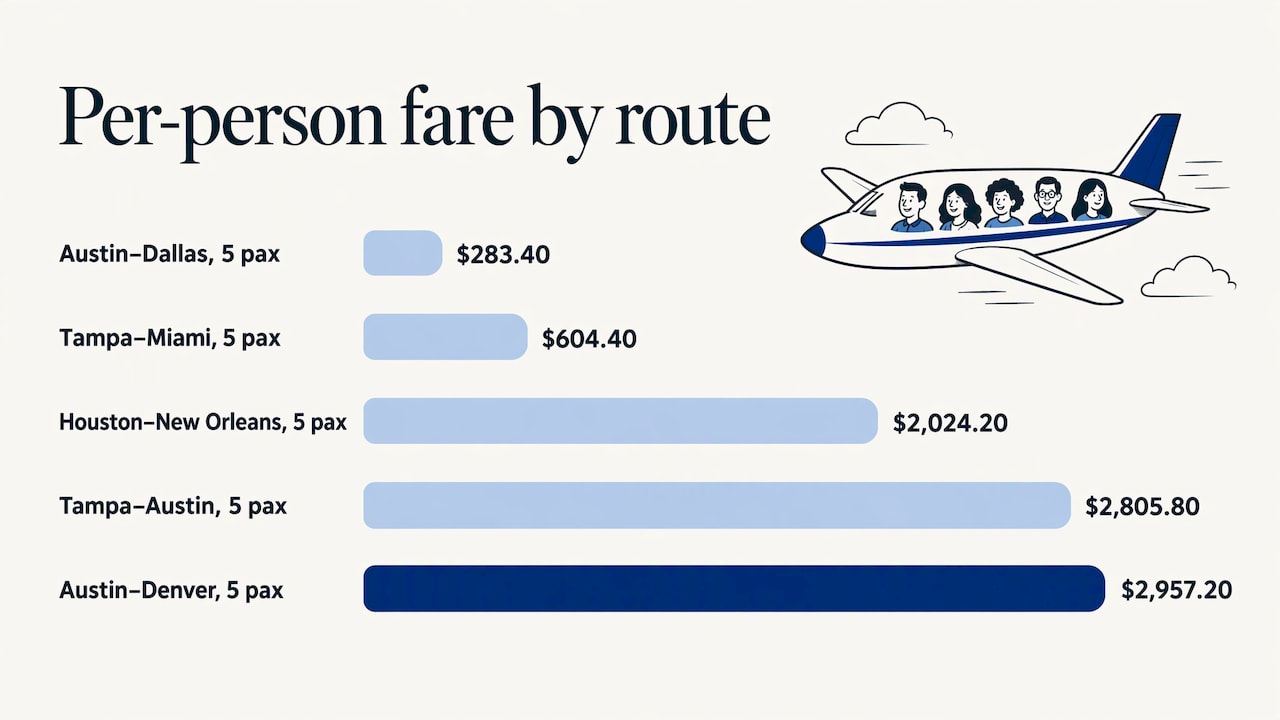
Here are listed routes, with the per-person split if the plane is full. The prices are as published on the Littlebird site when we last read them.
| Route | Whole-airplane price | Split by 2 | Split by 3 | Split by 5 |
|---|---|---|---|---|
| Austin to Dallas | $1,417 | $708.50 | $472.33 | $283.40 |
| Tampa to Miami | $3,022 | $1,511 | $1,007.33 | $604.40 |
| Houston to New Orleans | $10,121 | $5,060.50 | $3,373.67 | $2,024.20 |
| Tampa to Austin | $14,029 | $7,014.50 | $4,676.33 | $2,805.80 |
| Austin to Denver | $14,786 | $7,393 | $4,928.67 | $2,957.20 |
Two things stand out. First, each added traveler pulls the per-person figure down sharply, which is why families and small teams are the natural fit. Second, the price is the price: you see it before you commit, with no seat-by-seat surprises. Optional extras such as pets or catering can carry additional fees.
For how this compares to a scheduled airline ticket for the same group, see our breakdown of how three to five travelers change the cost math.
A worked example: Austin to Dallas
Take four colleagues going from Austin to Dallas for a day of meetings.
By car: about $152 in mileage cost on a 200-mile trip, using the IRS rate as the yardstick, plus tolls and parking. One person drives. Everyone loses the better part of a morning in transit each way.
By Littlebird: $1,417 for the airplane, which is $354.25 each with four aboard. You fly between regional airports, so there is no hub connection, and the group arrives together.
The flight costs more in cash. The question is what the hours are worth. If four people each get back even a few working hours, the gap closes quickly for a business team. For a family on a leisure trip, the gap is a price you pay for a day on vacation instead of a day on the highway. You decide what that is worth; the point is to put a number on it before you choose.
Our guide to where the hours actually come from walks through each stage of a door-to-door trip.
Door-to-door time: where flying pulls ahead
Speed in the air is only part of it. A private flight has its own overhead: getting to the departure airport, boarding, then getting from the arrival airport to your final stop. Regional airports tend to be small, so those ends are short.
The advantage grows with distance and with how awkward the drive is. These factors tilt the decision:
- Distance. Under roughly 100 miles, a car is hard to beat. At several hundred miles, the drive becomes a day.
- Where you start and end. If both airports are close to your actual origin and destination, flying pays off. If one end is far from the airport, some of the saving evaporates.
- Route geometry. Roads that wind, cross mountains or crawl through congested metro areas stretch the drive. A flight takes a more direct line.
- Time of day. Friday afternoon and Sunday evening traffic on busy corridors can add a lot to a drive. Flights are scheduled around you, not around a timetable.
- Party size. Up to five people means one price covers everyone, and nobody has to coordinate multiple cars or tickets.
- Number of stops. Several meetings in different towns in one day are awkward by car and straightforward when you can fly between regional airports.
The broader point is that Littlebird’s service connects regional airports that airlines often skip, so a trip that would otherwise mean driving to a hub and connecting can become one direct hop.
Safety: what the data says about flying vs driving
Most readers searching this topic want to know one thing: is it safe? The honest answer starts with how safe driving is not.
A Northwestern University study of U.S. data from 2000 to 2009 found automobile and light-truck occupants faced 7.3 fatalities per billion passenger-miles, against 0.07 for commercial aviation, about 112 times the risk. A more recent May 2026 report using federal data for 2016 to 2024 put light-duty vehicles at 626 times the per-mile fatality rate of scheduled commercial aviation.
The same Northwestern paper makes the daily-life comparison concrete: someone driving 30 miles a day for a year faces a fatality risk of about 1 in 12,500, versus about 1 in 85,000 for flying 500 miles every day.
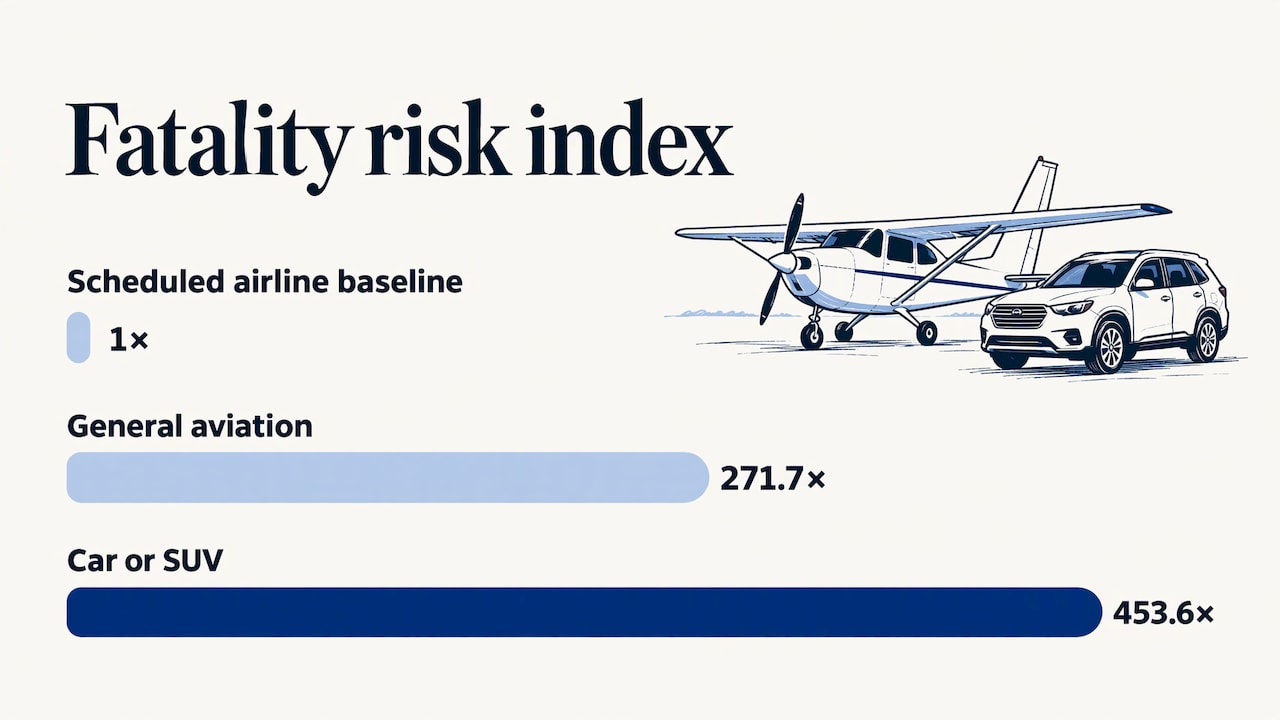
What about private aircraft specifically? A death-risk index compiled from NTSB, DOT and NHTSA data ranked general aviation at 271.7 times the risk of scheduled airlines, while driving or riding in a car or SUV was 453.6 times. By that measure, a private plane is safer than the family car.
Distance matters too. A University of Michigan study found that for average or high-risk drivers, nonstop flying is always safer than driving, and for a low-risk driver the crossover on rural interstates is 303 miles. That study is older, from 1990, but the logic still holds: the longer the trip, the more the safety case favors the air.
What Littlebird adds on top
All Littlebird flights use Cirrus aircraft with a whole-airframe parachute system, and pilots are professional and trained to standardized safety procedures. If you want to see how the parachute works, read our explanation of Cirrus CAPS. For the questions worth asking about any small aircraft flight, see our small aircraft safety guide, and for what governs the person in the front seat, what the FAA requires of pilots.
Privacy, comfort and the little things
Time and money are not the whole decision. On a charter, your group is the only group on board, which makes calls, working sessions and family conversation easier. There is no gate area, and no stranger in the next seat. Our piece on what privacy you get on a private flight covers it in detail.
In a car, you carry what fits in the trunk and you set your own stops. That freedom is real. The charter trade is a straighter path and a fixed arrival time.
How to decide: a quick routine
Run these five steps on any route you are weighing.
- Get the drive cost. Multiply the distance by the IRS mileage rate for the whole car, then add tolls and parking.
- Add the hidden costs. Count hotel nights, meals and the value of each traveler’s time. Write the figure down for each person.
- Get the flight price. Whole-airplane pricing appears instantly online, so you can see the exact number for your route without a call.
- Divide by who is traveling. The more people in the party, up to five, the lower the per-person share.
- Compare the totals and the hours. If the extra cost per person is less than the time you save is worth, fly. If the drive is short and the car is full, drive.
For mid-distance trips, one more question is which aircraft type suits the route. Our comparison of a light jet vs a turboprop for a regional trip helps with that.
Book your regional flight with Littlebird
If your numbers say the flight is worth it, Littlebird gives you the price up front. Enter your route on littlebird.aero to see the fixed price for the entire airplane, then split it among up to five travelers. Routes include Austin to Dallas, Tampa to Miami and Houston to New Orleans, plus flights between many smaller regional airports. Texas travelers can also browse Littlebird charter flights in Texas.

Booking is online, and payment is collected at checkout or when the trip is confirmed.
Our perspective
Most people think of private flying as a luxury reserved for a few. We built Littlebird on a different idea: the airplane is the unit you buy, not the seat. When you price the whole aircraft up front and let a group of up to five share it, a regional flight becomes something a family or a small team can weigh against the drive.
The comparison that matters is the one you run yourself. Count the day you lose on the highway, the hotel night, the meals, the missed evening at home. Then look at a flight between two regional airports that skips the hub and the security line.
We fly modern Cirrus aircraft with a parachute system for the whole airframe, and our pilots train to standardized safety procedures. That is how we think a regional flight should work: transparent price, trained pilots, an airplane designed with safety in mind, and your hours back.
Nick
FAQ
Is a private jet cheaper than driving?
Not in cash for a short trip: a car costs a set amount per mile no matter how many people ride in it. A whole-airplane charter becomes competitive when you count lodging, meals and time, and when up to five people share one fixed price. Run your own route to see where it lands.
Is flying privately safer than driving?
Per mile, federal-data studies show flying is far safer than driving. A widely cited death-index analysis also ranks general aviation as lower risk than driving or riding in a car or SUV. Littlebird adds a whole-airframe parachute system on every aircraft and standardized pilot safety training.
How far do I have to travel before flying makes sense?
There is no single cutoff, but the benefit grows with distance. Under about 100 miles a car is usually easier. Several hundred miles or more, especially across congested or winding routes, is where a direct flight between regional airports starts to save real hours.
How many people can share a Littlebird flight?
Up to five passengers can share the cost of one flight, because Littlebird prices the entire aircraft rather than individual seats. The more travelers in the party, the lower each person’s share of the fixed price.
Sources
- IRS standard mileage rates
- Northwestern University fatality-risk study of U.S. transportation modes
- Comparative Risk Metrics for U.S. Commercial Aviation, May 2026
- The Points Guy: how helicopters, planes, cars and trains compare on safety
- University of Michigan: Nonstop Flying Is Safer Than Driving
- Travel expense categories checklist
Recommended
Fly private with Littlebird
Instant prices for private Cirrus flights between regional airports, one price for the whole airplane.
Get a quote