
Private Jet Weight Limits: What Passengers and Bags Can Weigh
November 27, 2026
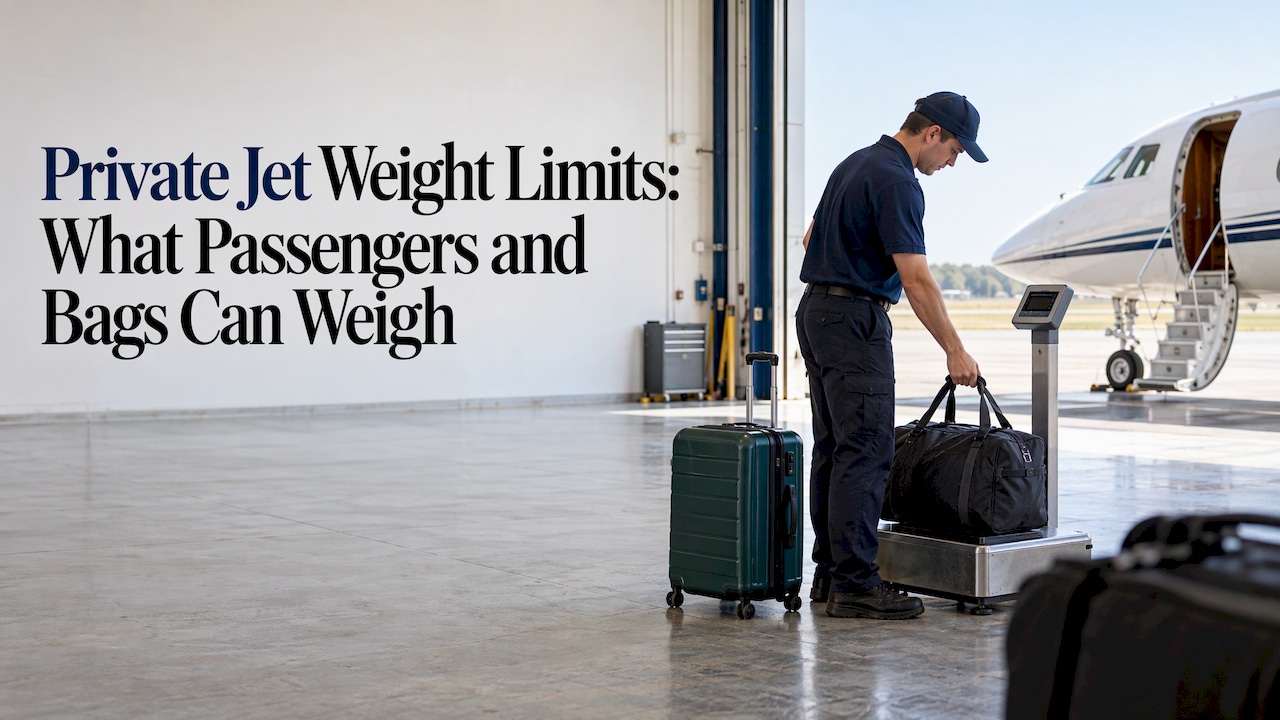
There is no single weight limit for private jets, and no per-person allowance like the one on an airline ticket. Every aircraft has its own certified limits, and what you can bring is what is left after the aircraft’s empty weight, its fuel and the pilot are accounted for. For a group of up to five flying on a Cirrus aircraft, that comes down to a simple habit: think in total party weight plus bags, not in suitcases per person. Booking the whole aircraft, as Littlebird flights work, means the cabin is yours and the load is planned around your group.
LittlebirdPlan a Regional Flight for Your GroupLittlebird’s Cirrus flights carry groups of up to five, with fixed pricing for the entire aircraft rather than a per-seat fare.VisitTL;DR
- Private aircraft are limited by total weight and by where that weight sits, not by a fixed bag count or a per-passenger cap.
- Payload is what is left for people and bags once fuel is counted. Useful load minus usable fuel equals payload.
- Seat count does not equal usable capacity: a plane with five seats is not automatically built to fill all five with adults, full bags and full fuel.
- Runway length, heat and altitude can lower what an aircraft can carry on a given day, so the limits are never one number.
- Tell the operator your group’s weights and bag count before the flight, so the load can be planned accurately.
Table of Contents
- Why private jets have weight limits at all
- The numbers that decide what you can carry
- Seat count is not carrying capacity
- How operators calculate the load before takeoff
- What changes the limit on the day
- Packing for a weight-limited cabin
- What this means for a regional trip
- Book a flight sized to your group
- Our view: plan the load, then enjoy the flight
- FAQ
- Sources
Why private jets have weight limits at all
Every certified aircraft is built and tested to fly safely up to a maximum weight, and within a range of balance points called the center of gravity (CG). Weight limits protect the climb, the stall speed and the control of the airplane. The FAA’s learning materials list what happens when a plane is overweight: longer takeoff runs, slower climb, lower maximum altitude, shorter range and higher stall and approach speeds.
So the question is not whether a limit exists, but how it shows up for you. On an airline, the limit is hidden behind a bag fee. On a private flight it is a conversation about total load.
The numbers that decide what you can carry
Four terms explain almost everything on a weight sheet.
- Basic empty weight: the aircraft as delivered, with its fixed equipment. The manufacturer supplies it, along with the empty-weight CG, when the certified aircraft leaves the factory.
- Useful load: the maximum allowable gross weight minus basic empty weight. This is everything the plane can carry: people, bags, cargo and fuel.
- Payload: useful load minus usable fuel. AOPA, citing the FAA definition, describes payload as the weight of occupants, cargo and baggage. Fuel is counted at about 6 lb per gallon for avgas and 6.8 lb per gallon for Jet A.
- Maximum takeoff weight (MTOW): the heaviest the aircraft may be when it starts its takeoff roll.
Larger jets add more limits. AOPA notes that most light jets have four maximum weights to respect: ramp, takeoff, landing and zero fuel, and all four must be met for the flight to be legal. Ramp weight is takeoff weight plus the fuel burned while taxiing, which on light jets is a difference of roughly 40 to 200 lb according to the same article.
A simple worked example
Take the Cirrus Vision Jet, one of the aircraft types Littlebird flies. Published specifications for an early production example list a maximum takeoff weight of 6,000 lb, a useful load of 2,499 lb and a baggage capacity of 300 lb. Those figures vary by individual aircraft and equipment, so treat them as an illustration of the structure, not a promise for any flight.
Now picture a group of four: two adults at 190 lb, one at 150 lb and one child at 70 lb. That is 600 lb of people. Add 120 lb of bags and you are at 720 lb of payload, well inside the 2,499 lb useful load before fuel is subtracted. Fuel for a short regional leg is only part of a full tank, which is why trip distance matters as much as passenger count.
The lesson: for most regional trips with a family or a small business team, the weight of people and ordinary luggage is manageable. The planning gets interesting when you add golf bags, sample cases, coolers or a fifth adult on a long leg.
Seat count is not carrying capacity
A common mistake is to read the seat count as a guarantee. AOPA’s training tip from November 2026 makes the point plainly: four seats do not mean the airplane can safely carry four adults and full fuel. Weight and balance has to be calculated so the aircraft is neither overloaded nor out of CG limits. The FAA’s learning center says the same thing in broader terms: in many four- and six-place airplanes, the fuel tanks may not be filled to capacity when a full complement of passengers and baggage is carried.
That is why fuel and people trade against each other. A shorter trip needs less fuel, which leaves more room for passengers and bags. This is a natural fit for regional flying between smaller airports, where legs are short and the fuel load is modest.
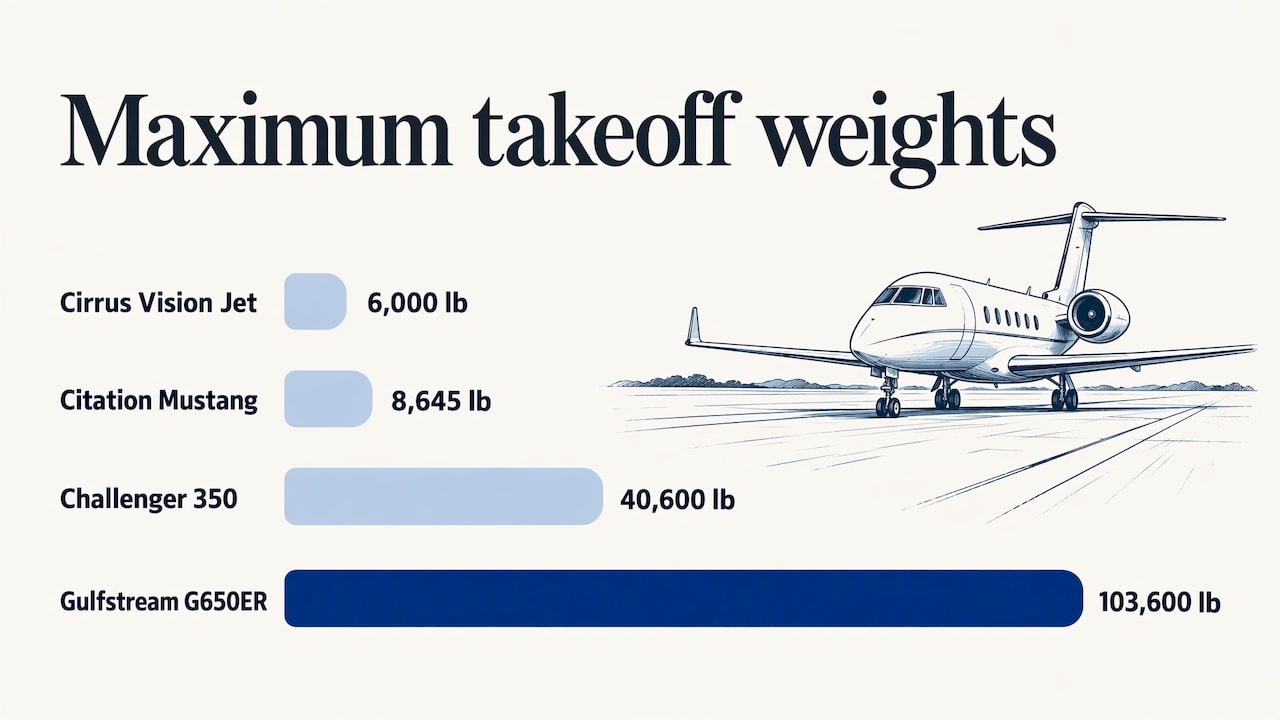
Bigger jets follow the same logic at a larger scale. Published maximum takeoff weights range from 6,000 lb for the Cirrus Vision Jet to 8,645 lb for a Citation Mustang, 40,600 lb for a Challenger 350 and 103,600 lb for a Gulfstream G650ER. More weight allowance means more room for fuel, people and bags, and also a higher hourly cost.
How operators calculate the load before takeoff
The FAA’s guidance on aircraft weight and balance control, Advisory Circular 120-27F, describes the standard method: add basic empty weight, passenger weight, cargo payload and fuel to get the takeoff weight. The operator builds a loading envelope for each aircraft covering maximum zero-fuel, takeoff and taxi weights, CG limits, floor loadings and compartment weights.
The pilot in command carries the final responsibility. The FAA’s Weight & Balance Handbook states that the pilot must know, before every flight, the maximum allowable weight and the CG limits of the aircraft.
Why your actual weights matter
For smaller aircraft, estimates are not enough. According to AC 120-27F, standard average passenger weights are meant for operators of larger multiengine turbine aircraft that meet specific criteria, and aircraft with fewer than five passenger seats must use actual passenger and baggage weights. In practice, the Cirrus-class aircraft used for regional trips are planned on real numbers, which is exactly what you want from a safety standpoint.
The guidance for actual-weight programs also says an operator may ask each passenger for their weight and should add at least 10 lb for clothing. Personal items, carry-ons and checked bags are weighed on a calibrated scale, and a heavy bag is any bag over 50 lb but under 100 lb.
This is not about judgment. A weight is a number on a loading sheet, the same as a bag. Giving an honest figure is the single most useful thing a passenger can do for a safe, comfortable flight.
What happens when the numbers are wrong
The NTSB is direct about the stakes. Between 2008 and 2016, improper or unperformed preflight weight-and-balance calculations were the probable cause of 136 general aviation accidents, one-third of them fatal. The same safety alert warns pilots not to guess passenger and cargo weights.
A documented 2013 case shows how small omissions add up. On a commercial Pilatus PC-12 flight, the trip schedule left out about 490 lb of carry-on coolers and food, and outdated passenger weights were used. The aircraft ended up about 4 inches aft of the CG limit and about 100 lb over maximum ramp weight, and the takeoff was aborted. The system worked because someone caught it, and the lesson for passengers is simple: mention every item you plan to bring, including the small ones.
What changes the limit on the day
A published MTOW is a ceiling, not a guarantee for every departure. The NTSB notes that even an aircraft under its maximum gross takeoff weight can lose enough performance from wind, high temperature and high density altitude to struggle to climb. Three practical effects follow:
- Hot afternoons and high airports reduce climb performance, so a load that is fine on a cool morning in Austin may need adjusting for a summer departure in Denver.
- Short runways can cap the weight an aircraft should take off with. Our guide to Vision Jet runway requirements explains what the published numbers mean.
- Fuel burn moves the balance. The CG shifts as fuel is used, so the calculation covers the whole flight, not only the takeoff.
FAA guidance also says operators should allow margins for loading variations and for passenger movement in flight, so that actual weight and balance stay inside certified limits from takeoff to landing.
Packing for a weight-limited cabin
The aircraft does not care about a bag’s brand, only its weight and whether it fits the baggage compartment. A few habits help on any small private aircraft.
- Count total weight, not bag count. Two soft duffels at 25 lb each are easier to load than one rigid 70 lb case.
- Choose soft-sided bags. They fit curved compartments better. Our article on private jet luggage by aircraft goes through what fits where.
- Declare the unusual items. Golf clubs, skis, instruments, coolers and sample cases all count toward the load. If your freight is more than personal baggage, private air cargo is the better fit.
- Check liquids and special items. The rules are different from airline security, and our page on liquids on private jets covers them.
- Plan the load like a group. If you manage bookings for a team, the logic is the same as sizing any group trip: luggage capacity planning per rider works from total volume and total weight, not from a headcount alone.
Pets and catering can also affect the load, and optional services such as these may carry additional fees.
What this means for a regional trip
Most of the people who search this question are not looking to carry heavy freight. They want to know whether the family, the golf bags and the weekend luggage will go on one flight. For short regional legs on a Cirrus aircraft, that is typically a question of planning a load of up to five people and their bags, with fuel sized for the trip.
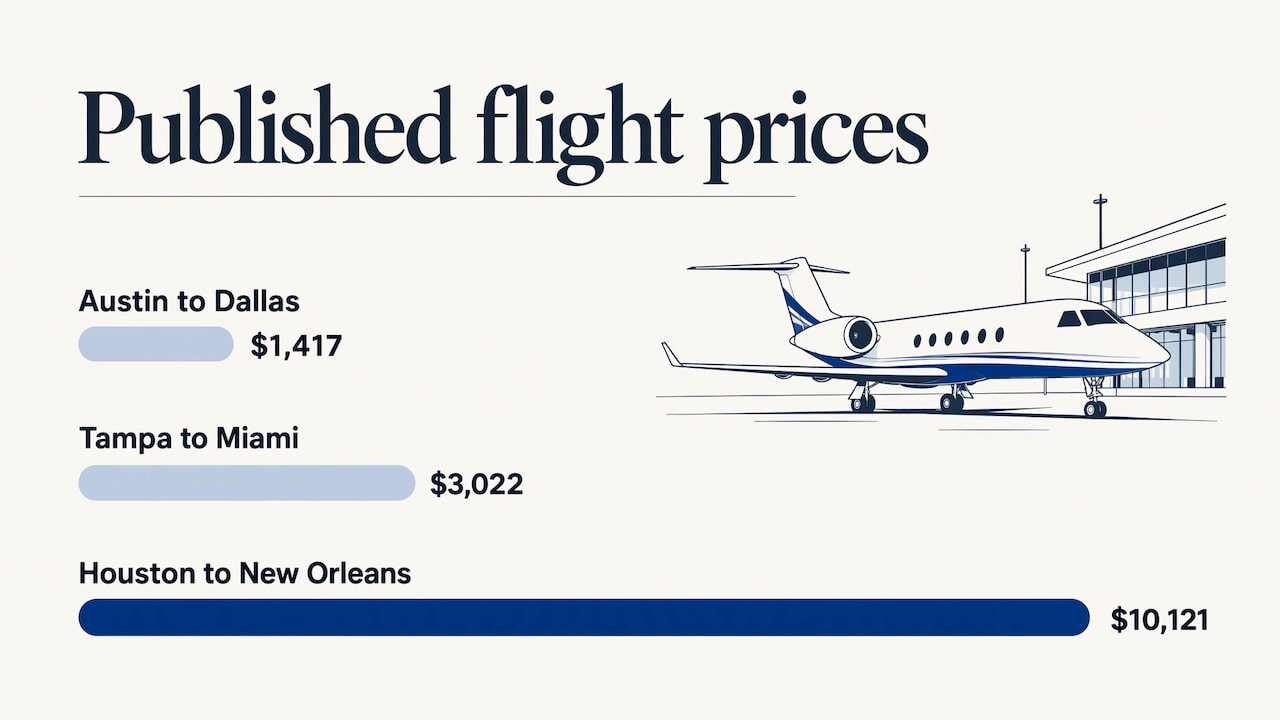
Littlebird flights are priced for the whole aircraft, not per seat, so the group shares one fixed price. Published instant prices include Austin to Dallas at $1,417, Tampa to Miami at $3,022 and Houston to New Orleans at $10,121, each one-off for the entire airplane. Whole-airplane pricing also means no one else’s luggage competes with yours for the compartment.
Who operates the flight matters for the rules that apply. The difference between commercial and private operations is covered in our explainer on Part 135 versus Part 91, and the pilot side is in what the FAA requires of private jet pilots. For a broader look at preparation, see our small aircraft safety guide.
Book a flight sized to your group
If you are flying with up to five people between regional airports, Littlebird gives you an instant online price for the whole airplane, flown on Cirrus SR Series and Vision Jet aircraft with the Cirrus Airframe Parachute System (CAPS) and standardized pilot safety training. You can see the price for your route and book online at littlebird.aero.

Routes such as Austin to Dallas, Tampa to Austin, Tampa to Miami, Houston to New Orleans and Austin to Denver show their fixed prices on the site, and there are also regional pages for New York, Utah, Oregon, Hawaii, Delaware and New Jersey.
Our view: plan the load, then enjoy the flight
Weight limits sound like a restriction, but they are really a planning tool. The same arithmetic that keeps an aircraft in balance is what lets a family of four and their bags travel without a hub connection, a security line or a checked-bag fee.
We built Littlebird around whole-airplane pricing for that reason. When you book the entire aircraft, the question is not how many bags each seat gets. It is what your group needs to carry, and what the aircraft can take on that route. A fixed price for up to five people means a team can split the cost, and a family can bring what the weekend requires.
Our Cirrus aircraft, with a whole-airframe parachute system and pilots trained to standardized safety procedures, are the kind of regional aircraft that suit short legs between smaller airports. Tell us what is coming along, and the flight is planned around it.
Nick
FAQ
Is there a weight limit per passenger on a private jet?
There is no fixed per-person cap. The limit applies to the whole aircraft: people, bags, cargo and fuel together must stay under the maximum weight and inside the balance limits. On smaller aircraft, actual weights are used rather than averages.
Does my weight count toward the limit?
Yes, as one number among many. Passenger weight, with an allowance for clothing, goes on the same loading sheet as bags and fuel. It is simply data for the weight and balance calculation, which the pilot in command must complete before every flight.
Can I fill every seat and bring full luggage?
Sometimes, and it depends on the aircraft and the trip. Seat count and payload are different measures, and fuel for the route is part of the equation. Shorter regional legs leave more room for people and bags than long ones.
Does weather change how much I can bring?
It can. High temperature, high airports and short runways reduce takeoff and climb performance, so the allowable load on a hot day can be lower than on a cool one. Planning covers this before departure.
Sources
- Proficiency: What is Payload? (AOPA)
- Mentor Matters: Juggling Weights (AOPA)
- Training and Safety Tip: Calculate, anticipate, aviate (AOPA)
- FAA Safety Alert 072: Minding Weight, Maintaining Balance (NTSB)
- FAA Learning Center: Aircraft Weight
- FAA Advisory Circular 120-27F
- AC 120-27F summary (OpenAirDocs)
- AC 120-27F full text (AirInsight)
- FAA Weight & Balance Handbook
- NTSB final report CEN13IA563
- Various Sizes: Different Types of Private Jets (Simple Flying)
- 2017 Cirrus SF50 Vision Jet Specifications (Plane & Pilot)
- Charter bus luggage capacity guide
Recommended
Fly private with Littlebird
Instant prices for private Cirrus flights between regional airports, one price for the whole airplane.
Get a quote