
Regional Airports Near Denver: Your Options Beyond DEN
November 25, 2026

Denver has more than one front door. Besides Denver International (DEN), the metro area has several public-use regional airports, including Rocky Mountain Metropolitan (BJC), Centennial (APA) and Colorado Air and Space Port (CFO). None of them has a terminal line or a hub connection. If you are flying a small group on a business trip, a family weekend or a mountain run, the airport you pick can save you more time than the aircraft you choose. Littlebird flies whole airplanes for up to five passengers between regional airports, so the fields below are the ones we think about every day.
Littlebirdlittlebird.aeroFly Between Regional AirportsLittlebird connects regional airports with on-demand private flights, with fixed pricing for the whole aircraft for groups of up to five.VisitTL;DR
- Metro Denver has DEN plus eight regional airports. Three of them, Centennial, Rocky Mountain Metropolitan and Colorado Air and Space Port, are FAA-designated reliever airports built to take general aviation traffic off DEN.
- BJC (northwest) and APA (south-southeast) are the closest to the city itself. Both sit roughly 12 nautical miles from Denver.
- Outside the metro, Boulder, Erie, Fort Collins-Loveland and Colorado Springs widen your choices along the Front Range.
- For ski towns and the Western Slope, the right airport is the one closest to your destination, not necessarily the one closest to Denver.
- Littlebird has charter pages for Denver, Boulder, Fort Collins, Grand Junction, Glenwood Springs, Durango and Montrose, priced per airplane, not per seat.
Table of Contents
- What “regional airport” means around Denver
- The airports closest to Denver
- Beyond the metro: Front Range options
- Mountain and Western Slope airports
- How to choose the right field for your trip
- Perspective
- Flying Littlebird around Denver and Colorado
- FAQ
- Sources
What “regional airport” means around Denver
In everyday speech, a regional airport is a smaller field away from the big hub. In aviation terms, the picture is more specific. Colorado’s airport system has 66 public-use airports, 13 with scheduled commercial service and 53 general aviation (GA) airports. General aviation simply means everything that flies outside scheduled airline service: private aircraft, charters, flight training and business flights.
Around Denver, a Metro Denver study counts DEN plus eight regional airports in the nine-county region, which together generate nearly $37 billion in annual economic output. Three of those are reliever airports: fields the FAA designates to give private and business aircraft a place to operate away from the airline traffic at DEN. That is exactly why they matter to you. A reliever has fuel, a runway long enough for any business aircraft, and no security checkpoint crowd.
The airports closest to Denver
The FAA’s aeronautical data, as compiled in a list of fields within 25 nautical miles of Denver (effective October 2026), counts seven public-use airports in that radius. A nautical mile is about 1.15 statute miles.
| Airport | Code | Direction and distance from Denver | Role |
|---|---|---|---|
| Rocky Mountain Metropolitan | KBJC | 11.9 nm northwest | FAA reliever |
| Centennial | KAPA | 12.0 nm southeast | FAA reliever |
| Denver International | KDEN | 15.3 nm northeast | Primary commercial service |
| Erie Municipal | KEIK | 16.2 nm north | General aviation |
| Colorado Air and Space Port | KCFO | 20.0 nm east | FAA reliever |
| Boulder Municipal | KBDU | 21.2 nm northwest | General aviation |
| Platte Valley Airpark | 18V | 24.7 nm northeast | General aviation |
The roles come from the Colorado aviation system’s airport classification and the Metro Denver study above.
Rocky Mountain Metropolitan (BJC)
BJC sits on the northwestern edge of the metro area, between downtown Denver and Boulder. The FAA says it is 20 miles west of DEN, with three runways and a control tower that operates from 6 a.m. to 10 p.m. local time. The Metro Denver study calls it the most convenient reliever to downtown and the fourth-busiest airport in Colorado. If your meeting is in Boulder, Broomfield, Westminster or north Denver, this is the field that keeps the ground leg short.
Centennial (APA)
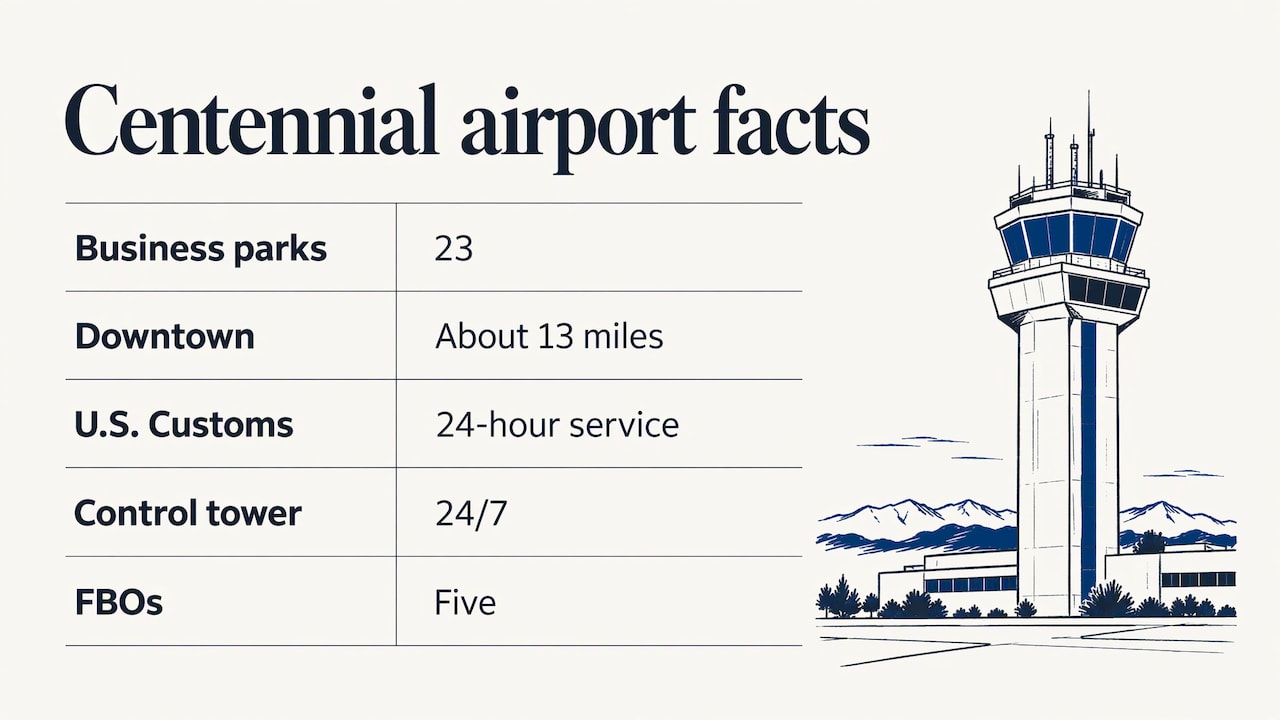
Centennial is the business traveler’s field in the south. NBAA describes it as sitting in the Denver Tech Center, surrounded by 23 business parks and about 13 miles from downtown, with 24-hour U.S. Customs and a 24/7 control tower. The FAA lists parallel runways and a third crosswind runway, and AOPA’s airport page shows five fixed-base operators (the on-field service companies that handle fuel, parking and passengers). Anyone headed to Englewood, Greenwood Village, Lone Tree or Parker will find it closer than DEN.
Colorado Air and Space Port (CFO)
CFO is the eastern reliever, about seven miles from DEN and spread over 3,200 acres. It suits flights to and from Aurora, the eastern plains and the I-70 and E-470 corridors.
Beyond the metro: Front Range options
A few more fields widen the map if you are flexible on where you land.
- Boulder Municipal (BDU). A general aviation field about 21 nautical miles northwest of Denver, useful when Boulder is the actual destination.
- Erie Municipal (EIK). North of the metro, handy for Erie, Longmont and the northern suburbs.
- Vance Brand (LMO), Longmont. AOPA’s page lists a single 4,799-foot runway and no control tower, with fuel, car rental and a flight school on the field.
- Northern Colorado Regional (FNL), Fort Collins-Loveland. Listed among the Denver-area GA facilities in the state’s study, and the natural field for Fort Collins and Loveland.
- Colorado Springs (COS). The city says the airport is about 12 miles southeast of downtown, with Denver a 70-minute drive north on I-25. It is a real alternative when your trip is really about the southern Front Range.
Mountain and Western Slope airports
Many people searching for airports near Denver are actually planning a trip into the mountains. In that case the useful question is how far you drive after landing.
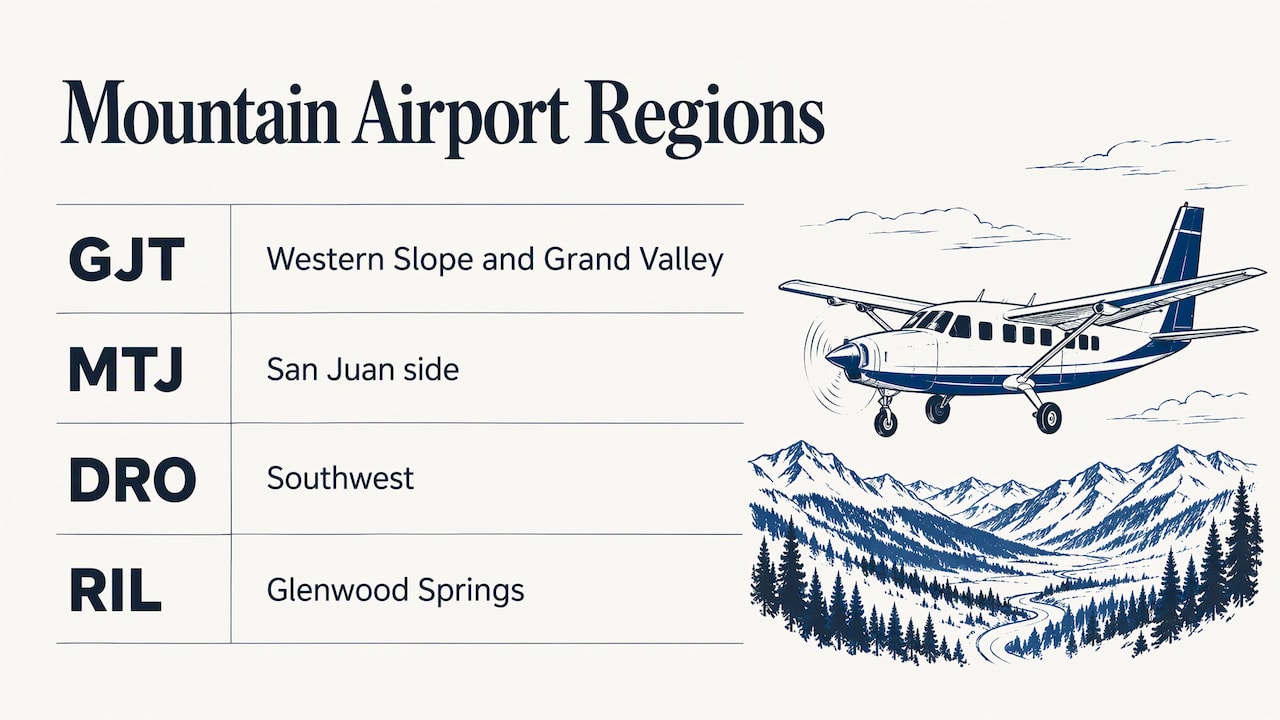
Take Vail. Discover Vail puts the town about 118 miles west of DEN via I-70, but only 35 miles from Eagle County Regional (EGE). The same logic applies across the state. Grand Junction (GJT) serves the Western Slope and Grand Valley. Montrose (MTJ) serves the San Juan side. Durango (DRO) serves the southwest. Rifle (RIL) serves Glenwood Springs. Rocky Mountain National Park is a different case: the National Park Service says DEN is the closest major airport, with no public transit to the park and commercial shuttles to Estes Park.
The point for a group is simple. The drive you skip is time you keep, and the saving grows with each person in the car.
How to choose the right field for your trip
Work through these questions in order.
- Where is the meeting, house or trailhead? Pick the airport nearest the real destination. For north Denver and Boulder that is BJC. For the Tech Center it is APA. For Vail it is EGE, not DEN.
- How many are you? Whole-airplane pricing rewards full cabins. Up to five people can share one fare, so the cost per person falls as the group grows.
- What hours do you need? Control towers have schedules. BJC’s tower runs 6 a.m. to 10 p.m., while APA’s is staffed around the clock, which matters for late arrivals.
- What does the ground leg cost? Add rental cars, parking and transfers. A field that saves 90 minutes of driving each way often settles the question.
- Do you need services on the ground? Centennial’s fixed-base operators handle fuel, ground transportation and more. Smaller fields may have fewer.
A practical example: a four-person sales team meeting in Boulder in the morning and in the Tech Center after lunch can fly in and out of fields that sit right beside those addresses, rather than crossing the metro twice by road.
Fares to the main hub are a separate question. KAYAK’s 12-month data shows DEN at an average of $325 for flights to Colorado. That is a per-seat airline fare, which is a different product from chartering a whole airplane.
Perspective
Most travelers think of private flying as a luxury for a few. We think of it as a geography problem. The United States has thousands of airports, and airlines use a few hundred of them. Denver is a good example: a dozen fields within an hour of the city, most with runways that suit our Cirrus aircraft, and almost none of them served by airlines.
That gap is why we price the whole airplane, up front, online. When you can see one fixed price for up to five people, you can divide it by the people in your row, not by a seat map. The airport you choose then becomes a choice about time and place, not about what the schedule happens to offer.
We fly Cirrus SR Series aircraft and the Vision Jet, and every one carries the Cirrus Airframe Parachute System. Our pilots follow standardized safety training. For families and business teams alike, that is the baseline we want before anyone boards.
Nick
Flying Littlebird around Denver and Colorado
Littlebird books private, whole-airplane flights between regional airports, with instant pricing online and room for up to five passengers. We have Colorado charter pages for Denver, Boulder, Fort Collins, Grand Junction, Glenwood Springs, Durango and Montrose, and an overview at private charter flights in Colorado.
For a sense of scale, our site lists Austin to Denver at $14,786 for the whole airplane. Optional extras such as pets or catering may carry additional fees. You can see current pricing for your route on littlebird.aero.

FAQ
How many airports are near Denver?
Metro Denver has DEN plus eight regional airports, according to the Metro Denver aviation study. Seven public-use fields lie within 25 nautical miles of the city, including BJC, APA, CFO, Erie and Boulder. Add Fort Collins-Loveland, Longmont and Colorado Springs if you are willing to go a bit farther.
Are DIA and DEN the same airport?
Yes. Denver International Airport is often called DIA, and its FAA code is DEN. FAA data places it about 16 miles northeast of Denver at an elevation of 5,433.8 feet.
Which Denver-area airport is closest to downtown?
BJC and APA are both about 12 nautical miles from Denver in opposite directions, BJC to the northwest and APA to the southeast. NBAA puts Centennial at about 13 miles from downtown. The better pick depends on whether your destination lies north or south of the center.
What is the cheapest airport to fly into in Colorado?
It depends on the period and route. KAYAK’s last-12-months data ranked Cortez at an average $245, Alamosa at $322 and Denver at $325 for airline fares. Airline fares are per seat, so compare them with the total cost of your whole group, including the drive after landing.
Which airport is best for Vail?
Eagle County Regional is only 35 miles from Vail, against about 118 miles from DEN, per Discover Vail. For a group, the shorter ground leg is the bigger part of the decision.
Sources
- 2025 Colorado Aviation Economic Impact Study
- Metro Denver Aviation Industry Cluster Study
- Airports near Denver, CO (FAA NASR-based list)
- Colorado airport role and classification analysis
- FAA: Rocky Mountain Metropolitan Airport (BJC)
- FAA: Centennial Airport (APA)
- NBAA: Centennial Airport (APA)
- AOPA: Centennial Airport (KAPA)
- AOPA: Vance Brand Airport (KLMO)
- City of Colorado Springs: Quick Facts About the Airport
- Discover Vail: Getting Here
- National Park Service: Rocky Mountain National Park directions
- FAA: Denver International Airport data
- KAYAK: Flights to Colorado
Recommended
Fly private with Littlebird
Instant prices for private Cirrus flights between regional airports, one price for the whole airplane.
Get a quote